Operations & Cost
Pallet Repair or Replace: A Component-by-Component Rule
By Bro Pallets LLC Team | Published August 25, 2026
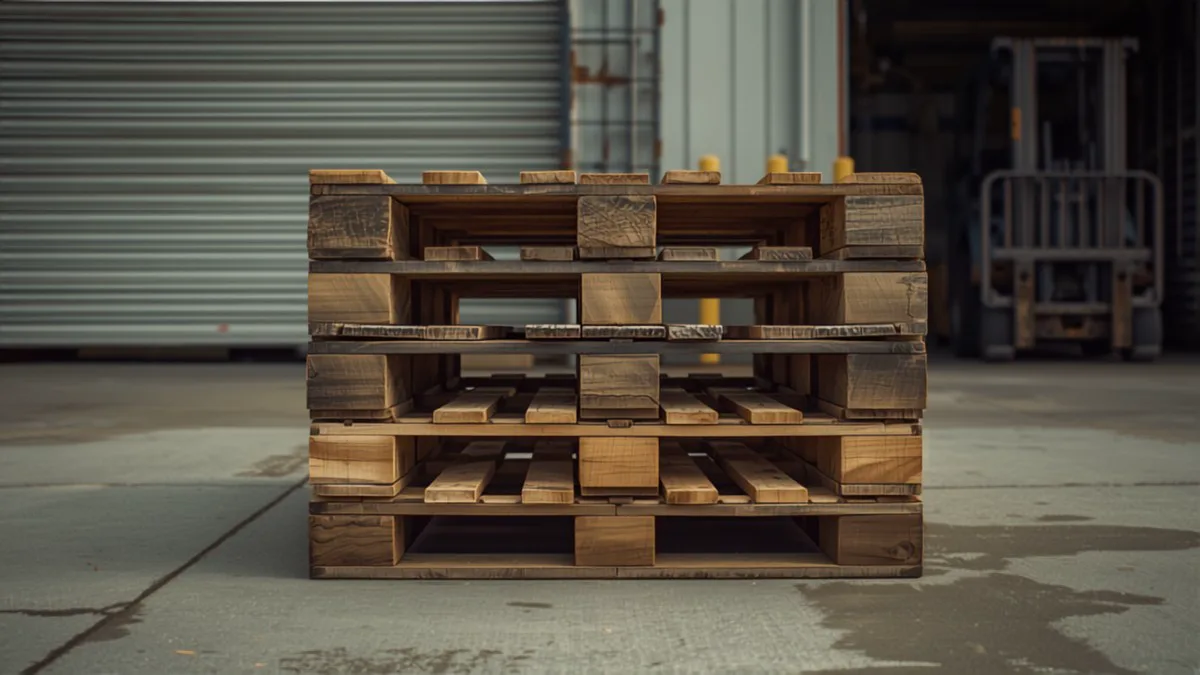
Every warehouse has the corner. Two hundred pallets nobody has looked at properly, some with a cracked board, some with a stringer that split the last time a forklift came in at an angle, a few that are honestly fine and got thrown on the pile because sorting takes time nobody has.
What usually happens next is that the pile keeps growing until it is in the way, and then a decision gets made under pressure, which is the worst condition for making it. Pallet repair or replace is not a complicated call on its own. It just needs to be made per component rather than per pallet.
Pallet Repair or Replace Is Not One Question
Two pallets can look equally broken from across the yard and belong in completely different piles. A cracked outer deck board and a split stringer both read as damage; only one of them removes the pallet from service.
The reason is where the load actually travels. In a stringer pallet, the stringers are the beams. They carry the load between forklift entries and they are what fails when the pallet is racked. Deck boards spread the load onto those beams. Losing a deck board reduces surface support; losing a stringer removes the beam. A pallet with a full-length crack through a stringer, particularly one running along the fork opening, is done regardless of how good the rest of it looks.
Block pallets distribute differently. The nine blocks carry the vertical load and the perimeter boards tie the structure together, which is part of why they hold up better in racking and automated systems. A damaged block is a more serious finding than a damaged deck board for the same reason a cracked stringer is.
The Component Rule
Sort on this and the pile resolves itself faster than expected.
| Damage | Practical verdict | Why |
|---|---|---|
| One or two outer deck boards cracked or missing | Repairable | Board replacement is straightforward and the beams are intact |
| Lead board (the one under the fork) broken | Repairable, priority | It is the first thing a fork hits; leaving it invites more damage |
| Stringer split along the fork opening | Out of service | The beam is compromised; a companion block repair is not a rated fix |
| Cracked or crushed block on a block pallet | Out of service | Blocks carry the vertical load path |
| Protruding or raised nails, no wood damage | Repairable, urgent | A snag and injury risk before it is a structural one |
| Soft, spongy or crumbling wood anywhere | Out of service | Decayed fiber does not carry rated load |
| Staining or discoloration, wood firm | Keep in service | Cosmetic unless the receiver has a sanitation program |
| Twisted or racked frame, pallet no longer sits flat | Out of service | It will not stack square and will not rack safely |
Two of those rows deserve a note. Protruding nails get treated as cosmetic and they are not: Cal/OSHA-conscious operations pull those pallets immediately, because a raised fastener is a hand injury and a torn bag of product waiting to happen. And staining is the row people get wrong in the other direction, scrapping sound wood over color. Our piece on mold and staining on wood pallets separates the cosmetic from the structural in more detail.
What Repairing In-House Actually Costs
The appeal of repair is that the material is already in the yard. The cost is everything around it, and it tends to be underestimated because it does not arrive as an invoice.
Someone has to pull the pallet apart, source lumber that matches the thickness of what is being replaced, drive fasteners properly, and confirm the result sits flat and carries. That is warehouse labor diverted from moving freight, on a bench that probably does not exist, using boards salvaged from other broken pallets whose condition nobody has verified. A repair built from questionable lumber produces a pallet that looks fixed and fails under load, which is worse than the broken one because it now travels under product.
There is also the export case, where in-house repair goes from inefficient to non-compliant. If an ISPM-15 stamped pallet has a component replaced with untreated wood, the pallet is no longer compliant and the stamp is now misleading, which is exactly the kind of finding that holds a shipment at a destination port. Repairs on treated pallets have to use treated lumber and be re-stamped by a certified facility. That is not a bench job.
Where in-house repair does earn its keep: closed-loop operations that never ship the pallet outside their own network, that already have a maintenance person and a nail gun, and that are replacing deck boards rather than beams. If that describes your operation, the math works. If it does not, repair is usually a way of paying warehouse wages to produce a lower-grade pallet than one you could have bought.
The Cost of Running a Degraded Pool
The pallets nobody decided about are not free while they sit there. They cost in ways that never get attributed back to the pile.
- Dock rejections. A receiver refusing a load over pallet condition means a return trip, a restack, or a scramble for replacements at whatever price is available that afternoon.
- Product damage. A pallet that fails mid-move takes the load with it, and the pallet was worth a fraction of what it was carrying.
- Handling time. Mismatched heights and twisted frames do not stack square, so trailers load slower and less densely. That shows up as labor and freight, not as a pallet problem.
- Racking risk. A pallet that was fine on the floor is a different proposition in a rack, where a stringer failure has consequences well beyond the load on it.
- Space. The corner holding the reject pile is warehouse square footage in one of the most expensive industrial markets in the country.
Where We Actually Fit
To be straight about it: we do not run a repair service at your facility. What we do is the other two sides of the same problem, which is usually what the yard needs anyway.
We take the reject pile. Our pallet pickup service covers Los Angeles County and Southern California, pickup schedules typically inside 24 to 48 hours, and the crew loads everything — broken, weathered, mixed sizes, no sorting required from you. Pickup is free on 50 or more, and for smaller quantities the fee is quoted up front.
Where the wood is still sound, we buy it instead. That is the part people miss when they call about disposal: reusable stock has value, and for operations generating pallets on a weekly basis a standing purchase agreement puts a set per-pallet price on volume you were treating as waste. Our guide to selling pallets in Los Angeles covers how those arrangements are structured, and the details are on our sell your pallets page.
And for replacement, the grade decision usually beats the repair decision on cost. Inspected Grade B pallets are structurally sound with cosmetic wear, which is the right specification for general warehousing and internal moves, and they arrive uniform, which is what makes a stack load square. If your loads go into racking, standard block pallets hold up better than stringer stock under repeat handling. The comparison in our article on recycled versus new pallets covers where each one pays off.
Do It Before the Fourth Quarter, Not During
Purging a pool is a slow-week job. In August and September the yard has room, the labor is available, and replacement stock is still easy to source. By November the same sort competes with peak outbound volume, and the pallets you need to replace the rejects are the ones everyone else is calling about.
Our yard sits on East 78th Street in South Los Angeles, with trucks running through Vernon and Commerce most days of the week, so a pickup and a replacement delivery can often be scheduled together rather than as two separate trips. If you are still deciding where to buy pallets at all, our pallet products page lists the sizes and grades we keep in stock.
Frequently Asked Questions
Is it cheaper to repair a pallet or replace it?
It depends on which component failed. Replacing a cracked deck board is inexpensive and keeps a sound pallet in service, while a split stringer or a crushed block means the load-carrying structure is compromised and repair is not a rated fix. Once you factor in warehouse labor, matched lumber, and the risk of a repair that fails under load, replacing with inspected Grade B stock is usually the better economics outside of closed-loop operations.
Can a pallet with a broken stringer be repaired?
Not in a way that restores its original capacity. Companion blocking alongside a split stringer is a common field fix, but the pallet should not go back into racking or under a heavy load afterward. For anything beyond light one-way use, a stringer failure is a replacement.
Do repairs affect ISPM-15 compliance?
Yes. If any component of a stamped pallet is replaced with untreated wood, the pallet is no longer ISPM-15 compliant even though the stamp is still on it. Repairs on export pallets must use heat treated lumber and be re-stamped by a certified facility, which is why in-house repair of treated stock is a compliance risk rather than a saving.
What can I do with pallets that are too damaged to use?
Call for a pickup rather than paying to dispose of them. We remove broken, weathered, and mixed pallets across Los Angeles County, free on 50 or more, and where the wood is still sound we buy the stock instead of charging for removal. Recurring pickup schedules are available for operations that generate volume weekly.
Clear the Pile Before Q4
Tell us roughly how many pallets you have and what condition they are in. We will quote the pickup, buy back what is reusable, and bring replacements on the same run — English or Spanish.
☎ (213) 703-5326 English
☎ (323) 674-6876 Español
REQUEST A FREE QUOTE