Quality & Inspection
Mold on Wood Pallets: What It Is, What It Is Not, and What to Do
By Bro Pallets LLC Team | Published August 25, 2026
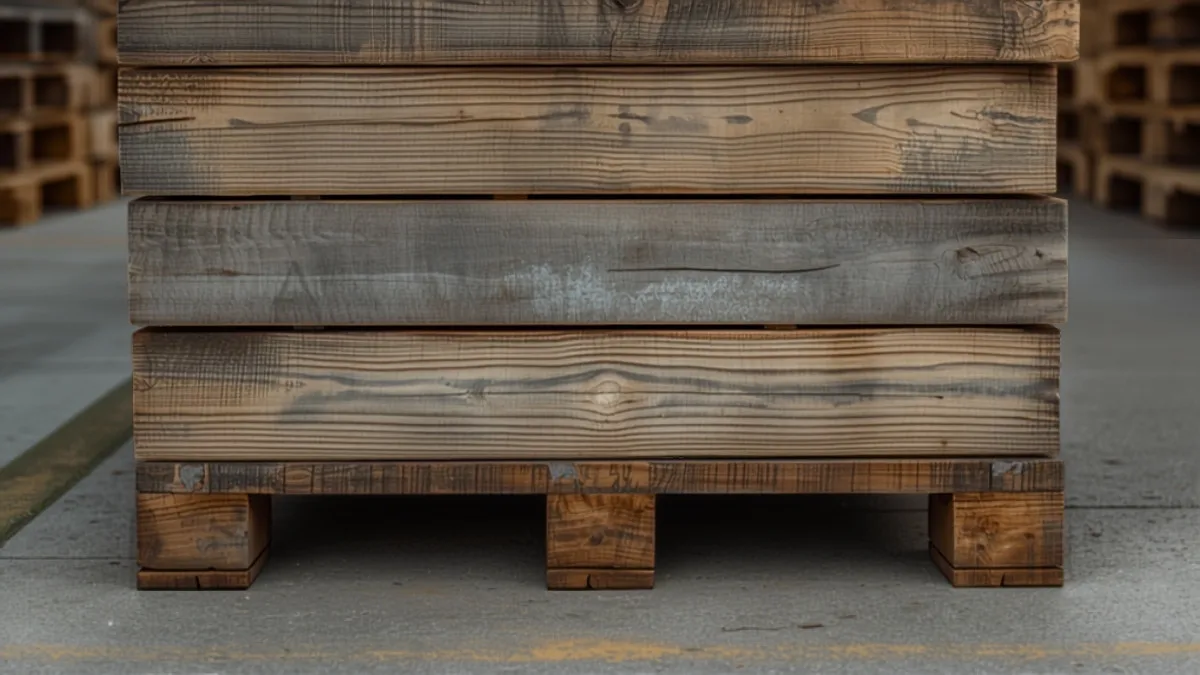
A driver drops a load in the yard, someone walks the stack, and there it is: gray streaking across the deck boards, a bluish cast down the stringers, maybe a dusty patch near the bottom of the pile. The call that follows is almost always the same question asked with real urgency — is this load ruined?
Most of the time the honest answer is no. But “most of the time” is not a procedure, and a receiving clerk staring at a discolored pallet at seven in the morning needs something better than reassurance. What is actually on that stack falls into three categories, and they carry three completely different consequences.
Three Different Things Get Called Mold
Mold on wood pallets is a label that gets applied to any discoloration on the boards, which is where most of the confusion starts. Separating the three takes about ten seconds once you know what you are looking at.
Blue stain (sapstain)
A bluish-gray or black cast that runs deep into the pale outer wood, following the grain rather than sitting on top of it. This is a staining fungus that lives on the sugars in the sapwood. It colors the wood and it does not consume the structural fiber, which is why a blue-stained deck board carries what it carried before. It cannot be brushed off, because it is not on the surface — it is in the wood. Cosmetically it looks alarming. Structurally it is close to a non-event.
Surface mold
Fuzzy or powdery growth sitting on the outside of the board, usually white, green, or black, often concentrated where two boards meet or where a stack sat against a wall. It wipes and brushes off, and it leaves behind wood that is otherwise sound. Surface mold is a symptom rather than a disease: it tells you the wood held moisture with no air moving across it. Remove the moisture and it stops.
Decay
This is the one that matters. Wood that has gone soft, spongy, or crumbly, that takes a screwdriver tip without resistance, or that has lost its edge definition. Decay fungi eat the fiber itself, and a stringer in that condition is no longer carrying its rated load no matter how clean it looks from three feet away. Decay is a scrap call, every time.
| What you see | Likely cause | Structural impact | Call |
|---|---|---|---|
| Blue-gray color in the grain, will not wipe off | Staining fungus in the sapwood | None | Usable; cosmetic only |
| Fuzzy or powdery patches that brush off | Trapped moisture, no airflow | None if the wood is firm | Dry it, clean it, fix the storage |
| Soft, spongy, crumbling wood | Decay fungi consuming fiber | Load capacity compromised | Pull it out of service |
| Dark rings or water lines, wood still hard | Past wetting that dried out | None | Usable unless the receiver is cosmetic |
The Heat Treatment Stamp Does Not Mean Dry Wood
Here is the assumption that costs people the most: an IPPC stamp on the stringer gets read as proof the pallet is sterile and dry. It is neither, and understanding why prevents a lot of unnecessary arguments with suppliers.
ISPM-15 heat treatment holds the core of the wood at 56 degrees Celsius for 30 continuous minutes. That specification exists for one purpose, which is killing wood-boring pests at every life stage so a pallet can cross a border. It is a pest kill, not a drying schedule. Kiln drying is the separate process that pulls moisture out of lumber, and kiln-dried wood may or may not have hit the ISPM-15 threshold. The two get confused constantly because both happen in a kiln.
What that means in practice: a properly stamped, fully compliant ISPM-15 heat treated pallet can absolutely grow surface mold, because nothing about the treatment stops the wood from picking up moisture again the moment it leaves the kiln. Treatment happens once. Weather happens continuously. A treated pallet that sits outside through a wet week behaves like any other piece of wood.
The same logic applies to the free and low-cost stock circulating around the city. Pallets that have been sitting behind a building for a month have absorbed whatever the weather delivered, and nobody inspected them on the way out. Our breakdown of where cheap and free pallets in Los Angeles come from covers what else tends to travel with them.
What Southern California Weather Actually Does
Los Angeles has a reputation for being too dry for this to be a problem, and for eight months of the year that is roughly true. The other four are a different story, and the pattern is specific enough to plan around.
The marine layer that pushes inland most mornings puts real humidity on everything stored outdoors, and in yards closer to the coast it burns off later in the day than people assume. Then the winter rains arrive, typically from December through February, and an uncovered stack holds water between the deck boards where nothing evaporates. Wood does not need to be soaked to grow surface mold. It needs to be damp, repeatedly, with still air around it. A tarp thrown over a stack with no ventilation underneath is one of the more reliable ways to produce exactly those conditions.
Geography inside the basin matters too. Yards in Vernon and Commerce sit inland enough that stacks dry out faster between wet spells, while operations closer to the port complex hold morning moisture noticeably longer. Neither is a reason to change suppliers. Both are a reason to change how the stack is set down. Our guide to outdoor pallet storage in Los Angeles goes deeper on drainage and lot layout.
What a Food or Pharma Receiver Will Actually Reject
This is where the cosmetic-versus-structural distinction stops being academic. A general warehouse and a food processing facility on Alameda Street apply different standards to the same pallet, and both are being reasonable within their own rules.
A food-grade or pharmaceutical receiver works under a sanitation program, and their inspector is not doing fiber analysis at the dock. Visible growth of any kind is a rejection, whether or not it is structurally meaningless, because the standard is documentary rather than engineering. Arguing that the discoloration is only sapstain will not change that outcome. If your loads go into those facilities, the practical response is to specify clean stock up front, or to move that lane onto plastic pallets, which are non-porous, washable, and cannot host growth in the first place. That trade-off is worked through in our piece on plastic pallets for food, pharma and cold storage.
General warehousing, internal transfers, and one-way outbound loads sit at the other end. Sound wood with cosmetic staining does the job, and paying a premium to avoid a color is money spent on nothing. Knowing which of your lanes is which is the whole exercise.
Keeping a Lot Dry Without Building Anything
Nearly every case of mold on wood pallets we get called about traces back to how the stack was set down rather than to what was delivered. The fixes are unglamorous and they work.
- Get the bottom pallet off the ground. Concrete wicks moisture upward and gravel holds it. A sacrificial pallet or a set of dunnage strips underneath keeps the stack out of standing water and lets air move under it.
- Leave air between stacks. Pallets pushed tight against each other and against a wall create still, damp pockets. A few inches of gap does more than any coating.
- Cover the top, not the sides. A tarp wrapped down to the ground seals moisture in. Cover the top surface and leave the flanks open so the stack can breathe.
- Rotate the yard. First in, first out is a quality control measure here, not just an inventory habit. The stack that has been in the corner since spring is the one that will surprise you.
- Inspect on receipt, not at use. Discoloration found at the dock is a supplier conversation. The same discoloration found when the pallet is already under product is a production stoppage. A short pallet inspection checklist at receiving catches it while it is still cheap.
- Do not seal wet wood indoors. Bringing a damp stack inside and shrink-wrapping it seals the moisture against the wood with nowhere to go. Let it dry in moving air first.
You Already Have a Lot That Is Affected
Sorting beats scrapping, and it takes less time than most operations expect. Pull the stack apart, press a screwdriver or a thumbnail into the stringers and the outer deck boards, and separate on firmness rather than color. Wood that resists goes back into service once it dries; wood that gives goes out.
The pile that fails is not worthless. We run pallet pickup across the county and take broken, weathered, and mixed stock off your hands, and where the wood is still sound we buy it rather than charge you to move it. That converts a corner of the yard you have been avoiding into space and, in many cases, a credit.
For the replacement side, the grade conversation matters more than the mold conversation. Grade B is structurally sound with cosmetic wear, which is exactly the right specification for general warehousing and internal moves, while Grade A earns its premium only where presentation or a receiver's program requires it. The sizes and grades we keep in the yard are listed on our pallet products page, and if you are still working out where to source pallets in the first place, that is where to start.
One more piece of timing. Yard cleanups are easiest to schedule now, in the weeks before fourth-quarter volume arrives and well before the winter rains do. Doing it in January means sorting wet wood in the mud.
Frequently Asked Questions
Is blue stain on a pallet the same thing as mold?
No. Blue stain, also called sapstain, is a fungus that colors the outer wood without consuming the structural fiber, so a stained deck board carries the same load it did before. It runs into the grain and cannot be wiped off. Surface mold sits on top of the wood and brushes away. Both look concerning; neither weakens the pallet the way decay does.
Do heat treated pallets prevent mold?
No. ISPM-15 heat treatment holds the wood core at 56 degrees Celsius for 30 minutes to kill pests, which is a phytosanitary requirement rather than a drying process. Once the pallet leaves the kiln it absorbs moisture like any other wood, so a fully compliant stamped pallet stored outside through a wet week can still develop surface growth.
Can I still use a pallet that has mold on it?
For general warehousing and internal transfers, yes, provided the wood is firm when you press it and the growth brushes off. For food, pharmaceutical, or cold storage receivers, no. Those facilities operate under sanitation programs where any visible growth is an automatic rejection at the dock regardless of whether the wood is structurally sound.
How do I keep pallets from growing mold in a Los Angeles yard?
Keep the bottom of the stack off the ground, leave gaps between stacks so air moves, and cover only the top rather than tarping down to the ground. Rotate stock so nothing sits untouched for months, and never shrink-wrap a damp stack. Most problems come from how pallets are stored rather than how they arrived.
Sorting a Stack You Are Not Sure About?
Send us what you are looking at and we will tell you straight whether it is cosmetic or scrap — and haul away what does not make the cut. English or Spanish.
☎ (213) 703-5326 English
☎ (323) 674-6876 Español
REQUEST A FREE QUOTE