Pallet Manufacturers
Pallet Manufacturers in Los Angeles: Local Builders vs National Brokers
By Maynor Martinez, Bro Pallets LLC | Published May 15, 2026
Search “pallet manufacturers near me” from a Los Angeles warehouse and you will get a mixed bag of results: actual local builders with saws running, national brokers with a 213 area code phone number routed to a call center, and out-of-state resellers drop-shipping from somewhere in the Midwest. They all look identical on a search results page. They are not.
The difference matters when your dock manager calls at 7 a.m. asking why the order is two days late, when your QA inspector flags inconsistent stringer thickness on a batch, or when you need a non-standard size built in three days. A real pallet manufacturer can answer those problems on the same call. A middleman cannot, because the people actually building your pallets are someone they have never met.
Manufacturer, Broker, Reseller: Three Very Different Businesses
The terms get used interchangeably online, which is exactly how brokers want it. Here is the practical breakdown of what each one actually does.
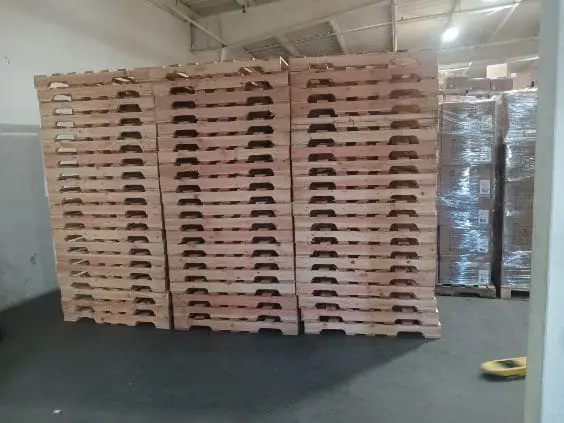
A pallet manufacturer owns a physical yard with saws, nail guns, dust extractors, and a crew that shows up to cut lumber every morning. They buy raw wood, build pallets from scratch, repair damaged ones, and ship finished product on their own trucks or a contracted fleet they manage directly. Their address corresponds to a building you can drive to. Bro Pallets LLC operates this way out of 1160 E 78th St in Los Angeles, in the Florence district of South LA just south of Vernon, inside the industrial corridor.
A broker takes your order, marks it up, and forwards the spec to whichever manufacturer has open capacity that week. The broker never touches the pallets. If a build goes wrong, the broker calls the actual factory and relays your complaint, which is why turnaround on quality disputes can stretch into weeks. Brokers are useful when you need volume across multiple regions; they are a liability when you need accountability on a single order.
A reseller stocks a warehouse of finished pallets bought from third-party manufacturers and resells them with a margin. They have inventory but no production. If you need a custom pallet size they do not currently stock, you wait while they place an order with their supplier, who places an order with their builder. By the time the pallets reach you, three businesses have added margin and lead time.
Why Manufacturer vs Broker Matters for Your Supply Chain
You are not buying pallets. You are buying the reliability of a platform that has to hold your product across a forklift, through a trailer, into a rack, and sometimes onto an international flight. Five things differ sharply between a direct manufacturer and a middleman.
- Quality control. A manufacturer inspects every pallet on the way out the door because their name is stenciled on it. A broker inspects nothing because the pallets never pass through their facility.
- Lead time predictability. A manufacturer knows their own production schedule down to the hour. A broker is guessing based on what their supplier told them last week.
- Custom capability. A manufacturer can build to spec in 3 to 5 days. A broker either says no, or quotes you a multi-week lead time while they shop the order around.
- Repair and buyback. A manufacturer with a yard can take damaged pallets back, repair the ones worth saving, and credit you on a future order. Most brokers cannot accept returns because they have nowhere to put them.
- Accountability. A manufacturer answers the phone with the foreman who watched the pallets get loaded. A broker reads from a CRM note written by someone else.
For an LA distribution center moving thousands of units per week, those differences translate into measurable downtime when something goes wrong. For a single-prototype order, they translate into whether the project happens at all.
Red Flags When Evaluating a Pallet Manufacturer
These are the warning signs that the company on the other end of the phone is not actually building anything. Any one of them is worth a follow-up question. Two or more, and you are talking to a middleman.
No Physical Address Listed
If the website lists only a phone number and a contact form, or the “address” on Google Maps points to a UPS Store, you are not dealing with a manufacturer. Real builders publish their yard address because customers, inspectors, and lumber suppliers all need to find it. Check the address on Street View. A warehouse with stacks of pallets and a forklift visible is a manufacturer. A house, a strip mall, or an office park is not.
No Facility Tour Offered
Ask if you can stop by the yard. A manufacturer will say yes immediately because they want you to see the operation. A broker will deflect with “we prefer to handle everything over the phone” or “our production facility is restricted access.” The yard is the entire pitch for a real builder.
No Custom Sizes Available
A manufacturer with their own saws can build any dimension. If the supplier only offers a fixed catalog of standard sizes and refuses anything off-list, they are reselling someone else’s inventory and cannot customize. The exception is plastic pallets, which require injection molds and are almost always sourced from a few national producers regardless of who you order from.
No Buyback or Pickup Program
A manufacturer with a yard wants used pallets back because they can repair Grade A and B units or recover lumber from broken ones. A reseller has no use for your surplus because they have no facility to process it. If “we buy pallets” is not part of the conversation, you are likely talking to a middleman.
Vague Lead Times
“Two to three weeks” for a standard 48x40 order is broker-speak for “I have to find someone to build this.” A manufacturer with the lumber and capacity on hand quotes in days for standard sizes, with longer windows only for heat treatment or specialty builds. If the lead time feels padded, it probably is.
Ten Questions to Ask Before Signing With a Pallet Manufacturer
Print these out and read them off the phone. The answers tell you whether the person on the other end runs a yard or runs a spreadsheet.
- What is your facility address, and can I visit? Yes or no, with a real street address.
- How many pallets per week can your yard produce at full capacity? A specific number, not a vague “we can handle any volume.”
- Where do you source your lumber? A manufacturer knows their suppliers; a broker has no idea.
- What is your current lead time for a 48x40 Grade B order of 500 units? Days, not weeks, from a real builder with stock lumber.
- Can you build a custom size, and what is the minimum order? A manufacturer will accept single prototypes. A broker will not.
- Are you ISPM-15 certified for heat treatment, and can I see the IPPC stamp on a sample? Real facilities have a treatment chamber and a registered stamp.
- Do you offer same-day or rush delivery within LA County? A local manufacturer with a fleet can. A drop-shipper cannot.
- Do you buy back used pallets or offer free pickup on surplus? A yard wants the wood back. A reseller does not.
- Who answers the phone if there is a quality issue on a delivered order? The foreman, not a customer service agent at a different company.
- Can your team handle the order in Spanish? In LA, bilingual operations are not optional for serious volume work.
If five or more answers come back vague, scripted, or with a callback promise that never arrives, move on. The pallet business runs on direct relationships, and brokers are not in that business.
Why Lumber Sourcing Decides Your Pallet Quality
The pallet you receive is only as good as the lumber that went into it. Manufacturers buy directly from sawmills or established lumber yards, often on standing weekly orders that lock in grade and dimension consistency. Brokers do not control any of that, which means the wood under your product was selected by someone several steps removed from your account.
Southern California has a real advantage on lumber supply. Softwood from the Pacific Northwest, hardwood routed through Long Beach, and recovered industrial lumber from regional mills all feed into the LA pallet supply chain. A manufacturer with a local lumber relationship can specify exactly what goes into each batch, swap softwood for hardwood on a reinforced build, and reject loads that come in below spec. For a deeper look at how lumber quality and grade translate into pallet performance, see our GMA grade A, B, and C guide.
Ask any prospective supplier whether they have direct lumber accounts or buy through brokers themselves. The answer tells you how much control they have over the finished product. A manufacturer buying lumber direct can hold prices stable through supply swings. A broker buying through another broker is at the mercy of two markups before the wood ever gets cut.
In-House Production vs Broker Scrambling: The Timeline Reality
Here is what a typical 1,000-unit custom 60x48 order looks like at each tier.
In-house manufacturer (Bro Pallets LLC): Day 1, quote confirmed by phone with the same person who walks the order out to the yard. Day 2, lumber pulled from stock, jigs set. Days 3 to 5, production runs. Day 6 to 7, inspection, optional ISPM-15 heat treatment, and load-out. Total: 5 to 7 business days to a dock in Vernon, Commerce, or the Inland Empire.
Broker workflow: Day 1, quote submitted by salesperson to internal email chain. Days 2 to 4, broker contacts two or three manufacturers asking for availability. Day 5, quote confirmed with whichever builder responds first. Days 6 to 12, production at a facility the broker has never visited. Days 13 to 14, freight scheduled from out of state. Total: 2 to 3 weeks, with no direct line to the actual builders if something goes sideways mid-production.
For standard sizes the gap is smaller because most manufacturers carry stock. For anything custom, reinforced, or treated, the broker model adds days of delay on every single touch point. If you need same-day delivery to Downtown LA or a rush order for the ports, only a local manufacturer with a fleet can deliver.
Bilingual Operations in LA: A Real Differentiator, Not a Tagline
Roughly half of the warehouse and logistics workforce in greater Los Angeles speaks Spanish as a primary language. Foremen, dock supervisors, drivers, and yard crews need to coordinate orders in the language they actually work in. A pallet manufacturer with full bilingual operations from the quote desk to delivery means your team is not stuck routing every question through a single person who happens to speak both languages.
Bro Pallets LLC runs separate English and Spanish phone lines staffed by actual team members, not voicemail forwarding. The Spanish line at (323) 674-6876 handles technical specs, volume negotiations, and delivery coordination the same way the English line at (213) 703-5326 does. National brokers with call centers in other states cannot match that, and it shows up the first time a dock manager needs to clarify a spec on a Friday afternoon.
The Case for a Local LA Manufacturer
Three things converge in Los Angeles that no out-of-state supplier can replicate. First, lumber supply: the Pacific Northwest pipeline plus the import flow through Long Beach gives local manufacturers a stable cost base. Second, port proximity: a yard sitting between the I-5 and the I-710 can deliver to dockside or recover empties off vessels with a turnaround other regions cannot match. Third, same-day capability: when your line goes down at 9 a.m. in Vernon, a manufacturer 15 minutes away can have replacement pallets on your dock before lunch.
That combination is why national brokers struggle in LA. They are competing against a tight cluster of builders who know the streets, the freeways, and the dock managers personally. For a closer look at how wholesale pricing reflects that local advantage, our bulk pallet buying guide for LA walks through volume tiers and what each one buys you. For current rate ranges, see our 2026 pricing breakdown. And if you are weighing timing on urgent orders, our LA delivery times guide covers what same-day actually looks like by zone.
When the question is “who should we trust with our pallet supply,” the manufacturer with a yard you can drive to, a fleet you can see, and a foreman whose name you know wins every time over a phone number that routes somewhere else.
Frequently Asked Questions
How do I know if a pallet supplier is a real manufacturer or a broker?
Check three things: a physical yard address you can verify on Street View, willingness to offer a facility tour, and the ability to build custom sizes in-house. A real manufacturer will pass all three. A broker will deflect on at least one. Bro Pallets LLC operates out of 1160 E 78th St in Los Angeles and welcomes facility visits by appointment.
What lead time should I expect from a local LA pallet manufacturer?
For standard 48x40 sizes in stock, same-week or even same-day delivery is achievable within LA County. For custom dimensions or reinforced builds, expect 3 to 5 business days. Heat treated ISPM-15 pallets typically add 2 to 5 days for treatment and stamping. Brokers and out-of-state resellers generally quote 2 to 3 weeks for the same scope.
Can a pallet manufacturer handle both small and large orders?
A real manufacturer with their own yard can. There is no strict minimum on custom pallet builds at Bro Pallets LLC, and capacity scales up to 5,000-unit orders without subcontracting. Brokers and resellers tend to push small orders away and add weeks of lead time on large ones while they coordinate with their supply network.
Why does it matter where the lumber comes from?
The wood determines the strength, dimensional consistency, and durability of every pallet you receive. Manufacturers with direct lumber supplier relationships control grade, thickness, and moisture content. Brokers buying through intermediaries have no visibility into what wood actually went into the build, which can mean inconsistent quality batch to batch and pricing that swings with their supplier’s markups.
Talk Directly to a Real LA Pallet Manufacturer
No call centers, no markups, no out-of-state routing. Call the yard, tell us your specs, and get a quote from the people who will actually build your order.
☎ (213) 703-5326 English
☎ (323) 674-6876 Español
REQUEST A FREE QUOTERelated Articles
Bulk Pallet Buying in LA
Volume tiers, negotiation tips, and what wholesale pricing actually buys you.
Custom Pallets Built to Spec
How custom dimensions, reinforcement, and turnaround work at our LA yard.
Pallet Prices in LA 2026
Current rate ranges by grade, size, and order volume in the LA market.
GMA Pallets: Grade A, B, C
Understanding pallet grades and how lumber quality affects performance.
LA Pallet Delivery Times
Same-day, next-day, and scheduled delivery windows by zone across LA.
Pallet Inspection Checklist
QC checklist for bulk deliveries: what to verify before signing off.