ISPM-15 & Heat Treated Pallets
What Is ISPM-15? The Complete Guide to Heat Treated Pallets for Export
By Maynor Martinez, Bro Pallets LLC | Published March 29, 2026
If your business ships goods internationally, you have almost certainly encountered the term ISPM-15. It is the single most important regulation governing wood packaging in global trade, and misunderstanding it — or ignoring it — can result in seized shipments, heavy fines, and damaged business relationships. This guide focuses exclusively on the regulation itself: what it says, who enforces it, which countries require it, what the official stamp markings mean, and what happens when you fail to comply.
For details on the actual heat treatment process and kiln specifications, see our technical guide to heat treated pallets. If you are shipping from the LA port complex and need practical logistics advice, our Port of LA export pallet guide covers that specifically.
What Does ISPM-15 Stand For?
ISPM-15 stands for International Standards for Phytosanitary Measures No. 15. It is a set of guidelines developed by the International Plant Protection Convention (IPPC), an agency under the United Nations Food and Agriculture Organization (FAO). The standard was first adopted in 2002 and has been updated several times since then, most recently to include additional approved treatment methods.
In plain terms, ISPM-15 is an international regulation that requires all solid wood packaging materials used in international trade — including pallets, crates, dunnage, and skids — to be treated to eliminate pests that could be hiding in the wood. The goal is to prevent the spread of invasive insects and plant diseases from one country to another through untreated wood. The regulation does not apply to processed wood products like plywood, particleboard, or oriented strand board (OSB), because the manufacturing process for those materials already eliminates pest organisms.
Why Was ISPM-15 Created?
The regulation exists because of a very real and documented threat: invasive wood-boring insects transported across borders inside untreated wood packaging. Before ISPM-15 existed, there was no unified global standard for treating wood packaging materials, and the results were catastrophic for ecosystems in multiple countries.
The Asian longhorned beetle, the emerald ash borer, and the pine wood nematode are three of the most destructive invasive species that have been directly traced back to untreated wood packaging used in international shipping. The Asian longhorned beetle alone has caused billions of dollars in damage to hardwood forests in North America and Europe. The emerald ash borer has killed tens of millions of ash trees across the eastern United States since its introduction. ISPM-15 was created as a global standard to prevent future introductions of this kind.
The regulation is not a suggestion or a best practice — it carries the force of law in every country that has adopted it, and non-compliance triggers real legal and financial consequences at the border.
Who Enforces ISPM-15?
ISPM-15 operates through a multi-layered enforcement system. The International Plant Protection Convention sets the standard, but enforcement is handled at the national level by each country's designated National Plant Protection Organization (NPPO).
In the United States
The USDA’s Animal and Plant Health Inspection Service (APHIS) is the NPPO responsible for ISPM-15 in the United States. APHIS accredits and audits treatment facilities, assigns unique facility registration numbers, and has the authority to revoke certifications from providers that fail to maintain compliance. APHIS also conducts random inspections of treated wood packaging at ports and border crossings.
At the Destination Country
When your shipment arrives at a foreign port, the destination country's NPPO is responsible for inspecting the wood packaging. Inspectors are trained to locate the ISPM-15 stamp, verify its components, and assess whether the wood packaging appears genuinely treated. Some countries are more aggressive about inspections than others. Australia, New Zealand, China, and EU member states are known for particularly rigorous enforcement.
The Role of the IPPC
The IPPC itself does not conduct inspections or impose fines. Its role is to maintain and update the standard, coordinate between national agencies, resolve disputes between countries, and provide guidance on implementation. When a country identifies a pattern of non-compliance from a specific trading partner, the IPPC facilitates the diplomatic process for addressing it.
Which Countries Require ISPM-15 Compliance?
As of 2026, over 180 countries have adopted ISPM-15 requirements. This makes it one of the most widely adopted international trade regulations in existence. The standard covers virtually every significant trading partner of the United States:
✓ Canada and Mexico
✓ All European Union member states
✓ United Kingdom (enforced independently post-Brexit)
✓ China, Japan, South Korea, Taiwan, and most of Asia
✓ Australia and New Zealand (among the strictest enforcers globally)
✓ Brazil, Argentina, Chile, and most of South America
✓ India, UAE, Saudi Arabia, and most of the Middle East
✓ Most African nations
The safest approach for any exporter is to assume ISPM-15 compliance is required unless you have confirmed a specific exemption in writing from the destination country's customs authority. Even countries that have been slow to adopt the standard may enforce it inconsistently, meaning a shipment that passed once without issues could be flagged the next time.
Countries with Stricter Requirements Beyond ISPM-15
Some countries impose additional phytosanitary requirements on top of the ISPM-15 baseline. Australia requires additional documentation and sometimes supplemental inspections. New Zealand has specific requirements for bark-free wood. China has been known to require fumigation certificates in addition to the ISPM-15 stamp for certain cargo types. Chile requires a phytosanitary certificate from the origin country's NPPO for some wood packaging shipments. Always research your specific destination's requirements beyond the ISPM-15 baseline.
What the ISPM-15 Stamp Means: Decoding the Markings
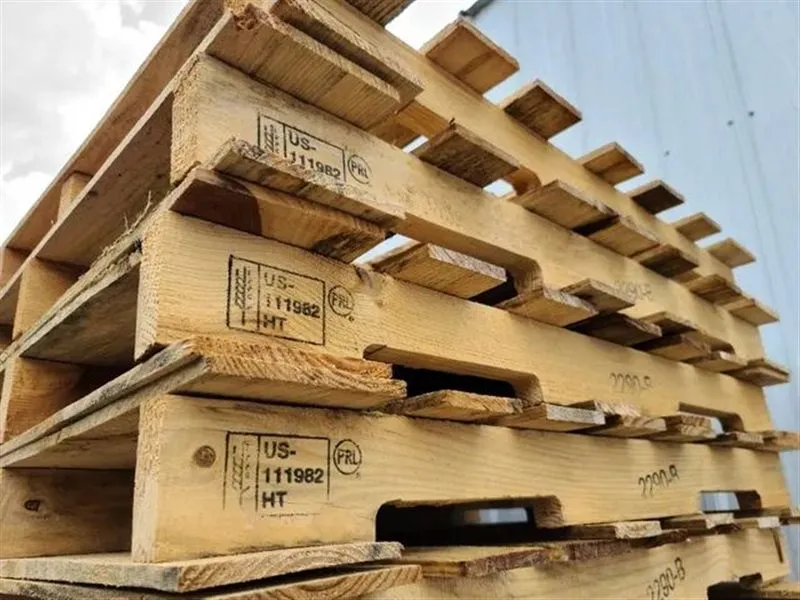
The official ISPM-15 mark branded onto compliant pallets is your proof that the wood has been properly treated. Customs inspectors around the world are trained to locate this stamp and verify its components. Understanding what each element means helps you confirm your pallets are genuinely compliant before they leave your facility.
Components of the IPPC Mark
The IPPC logo — A stylized wheat or grain symbol that identifies the mark as an official IPPC certification. This logo is internationally standardized and cannot legally be applied to untreated wood.
Country code — A two-letter ISO code identifying the country where the treatment was performed. For pallets treated in the United States, this reads “US.”
Producer/treatment provider number — A unique registration number assigned to the certified treatment facility by the national plant protection organization. In the US, APHIS assigns and maintains these numbers. This number creates a traceable link between the stamp on your pallet and the specific facility that treated it.
Treatment code — The abbreviation identifying the treatment method. “HT” indicates heat treatment (the most common). “MB” indicates methyl bromide fumigation (being phased out due to environmental concerns). “DH” indicates dielectric heating (a newer approved method). “SF” indicates sulfuryl fluoride fumigation (approved in some jurisdictions).
Stamp Placement Requirements
The ISPM-15 mark must be branded, stenciled, or stamped onto at least two opposite sides of the pallet so it remains visible regardless of orientation. The mark must be permanent — stickers and labels do not satisfy the requirement. The mark must also be legible. A stamp that has faded, been painted over, or been obscured by cargo strapping is treated as absent by customs inspectors.
Counterfeit and Fraudulent Stamps
Fraudulent ISPM-15 stamps are a real problem in international trade. Some unscrupulous suppliers apply the IPPC mark to untreated pallets, exposing their customers to serious legal and financial risk. If a customs inspection reveals that a stamped pallet has not actually been treated, the consequences fall on the shipper — not the supplier. Protect yourself by sourcing pallets only from APHIS-accredited treatment providers and keeping purchase documentation that ties each pallet order to a verified facility registration number.
Approved Treatment Methods Under ISPM-15
The regulation approves several treatment methods, each identified by a specific code on the stamp. Heat treatment (HT) is by far the most widely used and universally accepted method. For a detailed explanation of how the heat treatment process works technically, including kiln specifications and the temperature protocol, see our heat treatment technical guide.
Heat Treatment (HT)
The wood core must reach a specified minimum temperature and hold it for a minimum duration. This is the gold standard for ISPM-15 compliance and is accepted at every port worldwide. Heat treatment does not leave chemical residues and does not affect the structural properties of the wood.
Methyl Bromide Fumigation (MB)
Methyl bromide is a chemical fumigant that was one of the original approved treatments under ISPM-15. However, due to its ozone-depleting properties, it has been banned or restricted in many countries. The European Union, Canada, and several other major trading partners no longer accept MB-treated wood. For exporters, HT-stamped pallets are the safer choice because they are universally accepted.
Dielectric Heating (DH)
Dielectric heating uses microwave or radio frequency energy to heat the wood core. It was added as an approved treatment method in later revisions of ISPM-15. While effective, it is less commonly available than conventional heat treatment and may not be recognized by all destination countries' inspectors, simply because they encounter it less frequently.
Sulfuryl Fluoride (SF)
Sulfuryl fluoride is a newer fumigation option approved under ISPM-15. It does not deplete the ozone layer like methyl bromide, but its acceptance varies by country. Check with your destination's customs authority before relying on SF-treated pallets.
Penalties for Non-Compliance
The consequences of shipping on non-compliant pallets are serious and varied depending on the destination country. Understanding the full range of potential penalties helps explain why compliance is not something to gamble on.
Shipment Detention
The most common consequence is detention at the destination port. Your cargo is held while inspectors examine the wood packaging. During this time, you are typically responsible for port storage fees, which accumulate daily and can become substantial for extended holds.
Mandatory Fumigation or Re-Treatment
Many countries offer the option of fumigating or treating the wood at the destination port instead of rejecting the shipment outright. This sounds like a reasonable solution until you see the cost. Port-side fumigation is significantly more expensive than sourcing properly treated pallets in the first place, and you have no control over the timing or pricing.
Shipment Rejection and Return
Some countries — particularly Australia, New Zealand, and certain Asian nations — will reject the shipment entirely and require it to be returned to the origin country. The shipper bears the full cost of return shipping, which effectively doubles the transportation expense for that shipment.
Fines and Legal Penalties
Depending on the destination country, non-compliance can trigger fines imposed by the customs authority. Repeat offenders may face increased scrutiny on all future shipments, effectively adding delays and inspection costs to every container they send to that country.
Business Relationship Damage
Perhaps the most costly consequence is the one that does not show up on an invoice: damaged relationships with your buyers. A shipment that arrives weeks late because of a pallet compliance failure undermines your reliability as a supplier. In competitive markets, one delayed shipment can cost you a customer permanently.
Materials Exempt from ISPM-15
Not all packaging materials fall under ISPM-15. Understanding the exemptions can help you make smarter packaging decisions, especially for shipments where compliance logistics are challenging.
Processed wood products — Plywood, particleboard, oriented strand board (OSB), veneer, and other engineered wood products are exempt because the manufacturing process (heat and pressure) eliminates pest organisms.
Plastic pallets — Entirely exempt because plastic cannot harbor biological pests. Plastic pallets are a viable alternative for exporters who want to eliminate ISPM-15 compliance concerns altogether, though they come at a higher cost per unit.
Metal and corrugated packaging — Not covered by ISPM-15.
Wood thinner than 6mm — Very thin wood packaging materials are exempt because they cannot support pest organisms. However, this exemption rarely applies to pallets.
Get ISPM-15 Compliant Pallets from Bro Pallets LLC
Navigating ISPM-15 requirements does not have to slow down your export operations. We stock ISPM-15 certified pallets in standard and custom sizes, with delivery across the Los Angeles metro area and beyond. Every pallet carries a verified IPPC stamp from an APHIS-accredited facility. For Spanish-language support, visit Palets de Madera en Los Angeles, or read the dedicated export breakdown in Spanish at palets ISPM-15 para exportación. If you are shipping from the Port of Long Beach or Port of LA, see our practical export guide for logistics tips specific to the San Pedro Bay port complex.
Frequently Asked Questions
What is ISPM-15?
ISPM-15 stands for International Standards for Phytosanitary Measures No. 15. It is an international regulation developed by the IPPC (under the UN FAO) requiring all solid wood packaging materials used in international trade to be treated to eliminate pests. It has been adopted by over 180 countries and is enforced by each nation's plant protection organization.
Which countries require ISPM-15 compliance?
As of 2026, over 180 countries enforce ISPM-15 requirements. This includes Canada, Mexico, all EU member states, the United Kingdom, China, Japan, South Korea, Australia, New Zealand, Brazil, Argentina, India, and most nations in the Middle East and Africa. Some countries like Australia and New Zealand impose additional requirements beyond the ISPM-15 baseline.
Who enforces ISPM-15 in the United States?
The USDA’s Animal and Plant Health Inspection Service (APHIS) is the National Plant Protection Organization responsible for ISPM-15 enforcement in the United States. APHIS accredits treatment facilities, assigns registration numbers, conducts audits, and can revoke certifications from non-compliant providers.
What happens if my export shipment uses non-compliant pallets?
Non-compliant pallets can result in your shipment being detained at the destination port, fumigation at your expense, outright rejection and return to origin, fines from the destination country’s customs authority, and strained customer relationships due to delivery delays. The shipper bears the cost in every scenario.
Need ISPM-15 Heat Treated Pallets?
Get a fast quote on certified heat-treated pallets for your export shipments.
☎ (213) 703-5326 English
☎ (323) 674-6876 Español
REQUEST A FREE QUOTERelated Articles
How Heat Treatment Works
The technical process behind ISPM-15 compliance: kiln specs, temperature protocol, and how to verify your pallets.
Export Pallets from Port of LA
Practical logistics for shipping containers out of Los Angeles and Long Beach.
Wood vs. Plastic Pallets
Compare materials including ISPM-15 exemptions for plastic pallets.
Shipping Pallets: LTL & FTL Freight
After heat treatment: how to wrap, brace and palletize export freight to avoid port rejections.