Heat Treatment Process & Verification
How Pallet Heat Treatment Works: The Technical Guide
By Bro Pallets LLC Team | Published April 6, 2026
You know your export pallets need to be heat treated. But what does that actually mean? What happens inside the kiln? How hot does the wood really get, and for how long? How can you tell the difference between a properly treated pallet and one that just went through a standard drying process? This guide answers those questions with the technical detail that matters when you are evaluating suppliers, inspecting pallets before loading, or trying to understand why a shipment got flagged at customs.
For a full explanation of the ISPM-15 regulation itself — what it is, who enforces it, which countries require it, and what the penalties are — see our ISPM-15 compliance guide. If you need practical advice on shipping containers out of the San Pedro Bay port complex, our Port of LA export guide covers that specifically.
The Heat Treatment Protocol: 56°C / 132.8°F for 30 Minutes
The internationally mandated heat treatment protocol requires the wood to reach a core temperature of 56 degrees Celsius (132.8 degrees Fahrenheit) and hold that temperature for a minimum of 30 continuous minutes. This is the single most important specification in pallet heat treatment, and every element of it matters.
Core Temperature, Not Surface Temperature
The 56-degree requirement applies to the innermost point of the thickest piece of lumber in the pallet — not the surface temperature, not the air temperature inside the kiln, and not an average across the batch. The surface of the wood reaches the target temperature long before the core does. A pallet that feels hot to the touch may still have a core temperature well below 56 degrees Celsius. This is why proper monitoring with internal probes is critical and why simply placing pallets in a warm environment does not constitute legitimate heat treatment.
Why Exactly 56 Degrees and 30 Minutes?
This combination was established through extensive scientific research conducted by the International Plant Protection Convention (IPPC) and participating national agencies across multiple countries. Laboratory testing confirmed that 56 degrees Celsius sustained for 30 minutes at the wood core is sufficient to achieve complete mortality of all known pest organisms that could be present in wood packaging materials. This includes eggs, larvae, pupae, and adult insects, as well as fungal pathogens such as the pine wood nematode.
The research tested across multiple wood species, densities, and moisture content levels. The 56/30 combination represents the minimum threshold that achieves reliable pest eradication across all conditions. Some organisms die at lower temperatures, but the standard was set at a level that provides a safety margin across the full range of species and conditions encountered in global trade.
Continuous vs. Cumulative Time
The 30 minutes must be continuous. The core temperature must stay at or above 56 degrees Celsius for an unbroken 30-minute period. If the temperature dips below 56 degrees at any point during that window — even briefly — the clock resets. This is why treatment facilities monitor temperatures constantly throughout the cycle and why the process cannot be rushed or shortcut by raising temperatures faster.
Inside the Kiln: How the Treatment Process Works
Understanding what happens inside the kiln helps you evaluate whether a treatment provider is running a legitimate, properly monitored process versus cutting corners.
Kiln Design and Equipment
Certified treatment facilities use industrial kilns designed specifically for phytosanitary treatment. These are not the same as lumber drying kilns, although some facilities are equipped to perform both functions. A proper treatment kiln features insulated walls and ceiling to maintain uniform heat distribution, forced-air circulation systems that ensure even temperature throughout the chamber, calibrated temperature probes that monitor conditions at multiple points, and data logging equipment that records temperature readings throughout the entire cycle.
Loading and Probe Placement
Pallets are stacked inside the kiln with spacing that allows air to circulate between units. Temperature probes are inserted into representative wood samples at their thickest cross-section — typically the stringer or the center of the thickest deck board. The probes must reach the geometric center of the thickest piece of wood, because that is the last point to reach the target temperature. Proper probe placement is one of the most critical steps in the entire process. A probe that is not deep enough will read a higher temperature than the true core, potentially certifying a pallet that has not actually reached the kill temperature.
The Ramp-Up Phase
The kiln temperature is raised gradually. Rapid temperature increases can cause surface cracking, warping, and case hardening (where the outer shell dries and hardens while the interior remains moist and cool). Most facilities raise the ambient kiln temperature to somewhere between 70 and 80 degrees Celsius, which allows the wood core to reach 56 degrees within a reasonable timeframe without damaging the lumber. The ramp-up phase typically takes two to four hours depending on the wood species, thickness, initial moisture content, and starting temperature.
The Treatment Window
Once the internal probes confirm that the core of the thickest piece has reached 56 degrees Celsius, the 30-minute treatment window begins. The kiln maintains stable conditions throughout this period. Operators monitor the probe readings to ensure the core temperature stays at or above the threshold for the full 30 minutes without interruption. Most facilities continue the treatment beyond the minimum 30 minutes as a safety buffer.
Cool-Down and Post-Treatment
After the treatment window is complete, the pallets are allowed to cool gradually. Some facilities use a controlled cool-down cycle within the kiln, while others move the pallets to a staging area. The total cycle time from start to finish — including loading, ramp-up, treatment, and cool-down — typically ranges from four to eight hours for a standard batch. Thicker lumber or higher moisture content extends the cycle.
Record Keeping and Audit Trail
Certified treatment facilities maintain detailed records of every treatment cycle. These records include the date and time of the cycle, batch identification numbers, kiln temperature readings at regular intervals, internal probe readings throughout the cycle, the exact time the core reached 56 degrees Celsius, confirmation that the 30-minute hold was achieved, and the operator responsible for the cycle. These records are subject to audit by the national plant protection organization (APHIS in the United States) and must be retained for a specified period. When you purchase heat treated pallets, you can request treatment certificates or batch documentation from your supplier as proof of legitimate treatment.
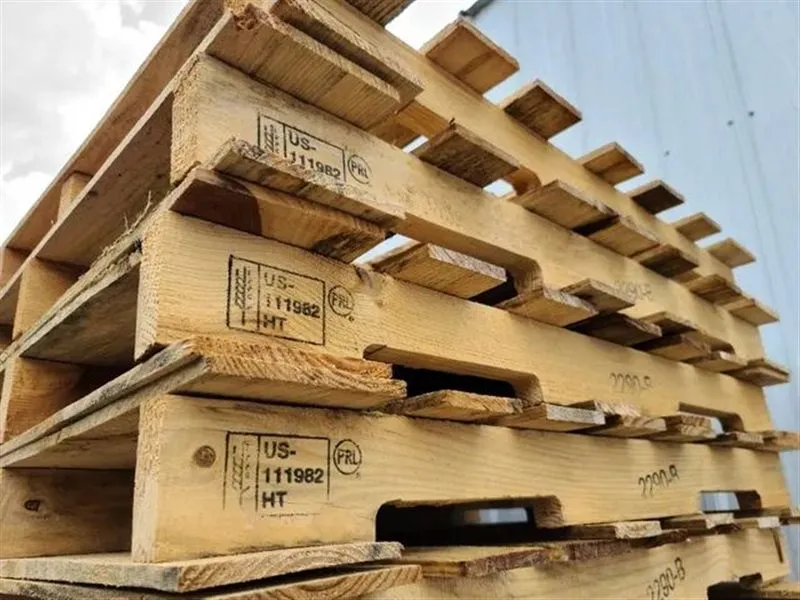
Reading the HT Stamp: What Each Element Means
After successful treatment, each pallet is branded with the official ISPM-15 mark. This stamp is the physical proof that the pallet has been through a certified treatment process. Knowing how to read it helps you verify compliance before your pallets leave the warehouse.
The IPPC Logo
A stylized wheat or grain symbol that identifies the mark as an official IPPC certification. This logo is standardized internationally and cannot legally be applied to untreated wood. Its presence is the first thing to look for when checking a pallet.
Country Code
A two-letter ISO code identifying the country where the treatment was performed. For pallets treated in the United States, this reads “US.” If you receive pallets stamped with a different country code, the treatment was performed in that country — which is fine for compliance purposes, as long as all other stamp elements are present and the treatment code is valid.
Facility Registration Number
A unique number assigned to the certified treatment provider by the national plant protection organization. In the US, APHIS assigns and maintains these numbers. This number creates a traceable link between the stamp on your pallet and the specific facility that treated it. If a compliance issue ever arises, this number allows investigators to trace the pallet back to its source.
Treatment Code
The abbreviation identifying the treatment method: “HT” for heat treatment (the most common and universally accepted), “MB” for methyl bromide fumigation (being phased out), “DH” for dielectric heating, or “SF” for sulfuryl fluoride. For maximum acceptance worldwide, HT-stamped pallets are the safest choice.
Where to Find the Stamp
The mark is branded or stenciled onto at least two opposite sides of the pallet so it remains visible regardless of how the pallet is oriented. Before loading your export shipment, physically check each pallet to confirm the stamp is present, legible, and complete on both sides. A stamp that is faded, painted over, or obscured by strapping will be treated as absent by customs inspectors.

Heat Treated vs. Kiln Dried: A Critical Distinction
This is one of the most common sources of confusion in pallet compliance. Kiln dried (KD) and heat treated (HT) are two different processes with different purposes, different standards, and different certifications. Using one in place of the other can result in a non-compliant shipment.
What Kiln Drying Does
Kiln drying is a moisture reduction process. Lumber is placed in a kiln and heated to reduce its moisture content, typically to somewhere between six and twelve percent depending on the intended use. The primary goal is dimensional stability — dry wood shrinks less, warps less, and is lighter to ship. Kiln drying is a lumber quality process focused on the physical properties of the wood. It is not a phytosanitary treatment, and it is not monitored or certified to meet pest eradication standards.
What Heat Treatment Does
Heat treatment is specifically a pest eradication process. The goal is biological kill — ensuring that the wood core reaches 56 degrees Celsius for 30 continuous minutes to destroy all pest organisms. While some moisture reduction occurs as a side effect of the heating process, moisture reduction is not the purpose. The treatment is monitored with internal probes, documented, and certified by an accredited facility.
Why a KD Stamp Does Not Equal an HT Stamp
Many kiln drying schedules operate at temperatures above 56 degrees Celsius. A reasonable person might assume that if the wood got hotter than 56 degrees during drying, it should also qualify as heat treated. But there are two problems with that assumption. First, the core temperature of the thickest piece must reach 56 degrees for 30 continuous minutes — and kiln drying schedules are not designed or monitored to guarantee this at the core. The surface may reach that temperature while the core does not. Second, even if the temperature threshold was reached, the process was not monitored, documented, and certified by an APHIS-accredited facility, which means it cannot legally carry the HT stamp.
A pallet carrying only a KD stamp is not ISPM-15 compliant and will not pass customs inspection at any destination that enforces the regulation.
Dual HT/KD Stamping
Some treatment facilities perform both processes simultaneously — heat treating to the 56/30 standard while also achieving kiln-dried moisture content levels. These pallets carry both HT and KD designations on the stamp. But only the HT marking satisfies export compliance. The KD designation is a bonus for lumber quality, not a substitute for HT.
How to Verify Your Pallets Are Truly Compliant
A systematic inspection before loading takes minutes and prevents expensive problems at the destination port. Here is how to verify that your pallets have been legitimately treated.
Visual Inspection Steps
- Locate the stamp on both sides — Check at least two opposite faces of each pallet. The stamp should be clearly branded or stenciled, not printed on a label or sticker.
- Verify all stamp components — Confirm the IPPC logo, country code (US), facility registration number, and treatment code (HT) are all present and legible.
- Look for repairs with untreated wood — Boards that are a different color, newer in appearance, or show a different wear pattern than the rest of the pallet may indicate an untreated repair. A pallet repaired with untreated lumber loses its compliance status entirely, even if the original HT stamp is still visible.
- Check stamp legibility — If any part of the stamp is faded, smudged, or obscured, set the pallet aside. A stamp that an inspector cannot read is treated as no stamp at all.
- Inspect all wood in the shipment — Dunnage, blocking, bracing, crating, and any other solid wood components must also carry an ISPM-15 mark or be made from exempt materials (plywood, particleboard, OSB).
Questions to Ask Your Pallet Supplier
Before placing an order for heat treated pallets, ask your supplier these questions to verify they are providing legitimately treated products:
- Is your treatment facility registered with APHIS? What is your facility registration number?
- Can you provide treatment certificates or batch documentation for my order?
- Do you use calibrated internal temperature probes during every treatment cycle?
- Are your treatment records available for review if a compliance question arises?
- Do you carry both standard and custom pallet sizes with HT certification?
A reputable supplier will answer these questions without hesitation. Reluctance or vague answers should be a red flag. View our full range of pallet products, all available with verified HT certification.
What to Do If You Find Non-Compliant Pallets
If your inspection reveals pallets without proper stamps, pallets with illegible stamps, or pallets repaired with untreated wood, do not load them. Replace them with verified compliant pallets before proceeding. If you need replacements on short notice, plastic pallets are an ISPM-15 exempt alternative that requires no stamp or treatment. For a full breakdown of the wood vs. plastic decision, see our comparison guide.
Do Heat Treated Pallets Expire?
No. The ISPM-15 stamp does not carry an expiration date. Once a pallet has been properly heat treated and stamped, the certification remains valid indefinitely — as long as the pallet remains structurally intact and no untreated wood has been added through repairs. There is no need to re-treat pallets annually or on any other schedule.
However, there are two scenarios where a previously compliant pallet becomes non-compliant: if a damaged board is replaced with untreated lumber (even one board invalidates the entire pallet), or if the stamp becomes illegible through handling, weathering, or refinishing. In either case, the pallet should be retired from export use or sent back through the treatment process.
Frequently Asked Questions
What temperature must the wood core reach for heat treatment?
The wood must reach a core temperature of 56 degrees Celsius (132.8 degrees Fahrenheit) and hold that temperature for a minimum of 30 continuous minutes. This applies to the innermost point of the thickest piece of lumber in the pallet, not the surface temperature or the ambient kiln temperature.
Is kiln dried the same as heat treated?
No. Kiln drying is a moisture reduction process focused on dimensional stability, while heat treatment is a pest eradication process certified to meet specific core temperature requirements. A kiln dried (KD) stamp does not satisfy ISPM-15 export compliance. Only the HT designation confirms that the pallet meets the 56°C / 30-minute protocol.
Do heat treated pallets expire?
No. The ISPM-15 HT stamp does not have an expiration date. The certification remains valid as long as the pallet is intact and no untreated wood has been added through repairs. There is no annual re-treatment requirement.
How can I verify my supplier is providing legitimately treated pallets?
Ask for the supplier’s APHIS facility registration number, request treatment certificates or batch documentation, and verify that the ISPM-15 stamp on each pallet includes all required components: IPPC logo, country code, facility number, and HT treatment code. A reputable supplier will provide this information without hesitation.
Need ISPM-15 Compliant Pallets for Export?
Bro Pallets LLC supplies certified heat treated pallets to exporters near the Port of LA and Long Beach. Standard sizes, custom dimensions, and reliable delivery to your loading dock. Get your quote on heat treated pallets today.
☎ (213) 703-5326 English
☎ (323) 674-6876 Español
REQUEST A FREE QUOTERelated Articles
ISPM-15 Regulation Guide
The law behind export pallets: who enforces it, which countries require it, and penalties for non-compliance.
Export Pallets from Port of LA
Practical logistics for shipping containers out of Los Angeles and Long Beach.
Wood vs Plastic Pallets
Side-by-side comparison on cost, durability, hygiene, and ISPM-15 exemptions.