Plastic Pallets
Types of Plastic Pallets: Nestable, Stackable and Rackable Explained
By Maynor Martinez, Bro Pallets LLC | Published June 16, 2026
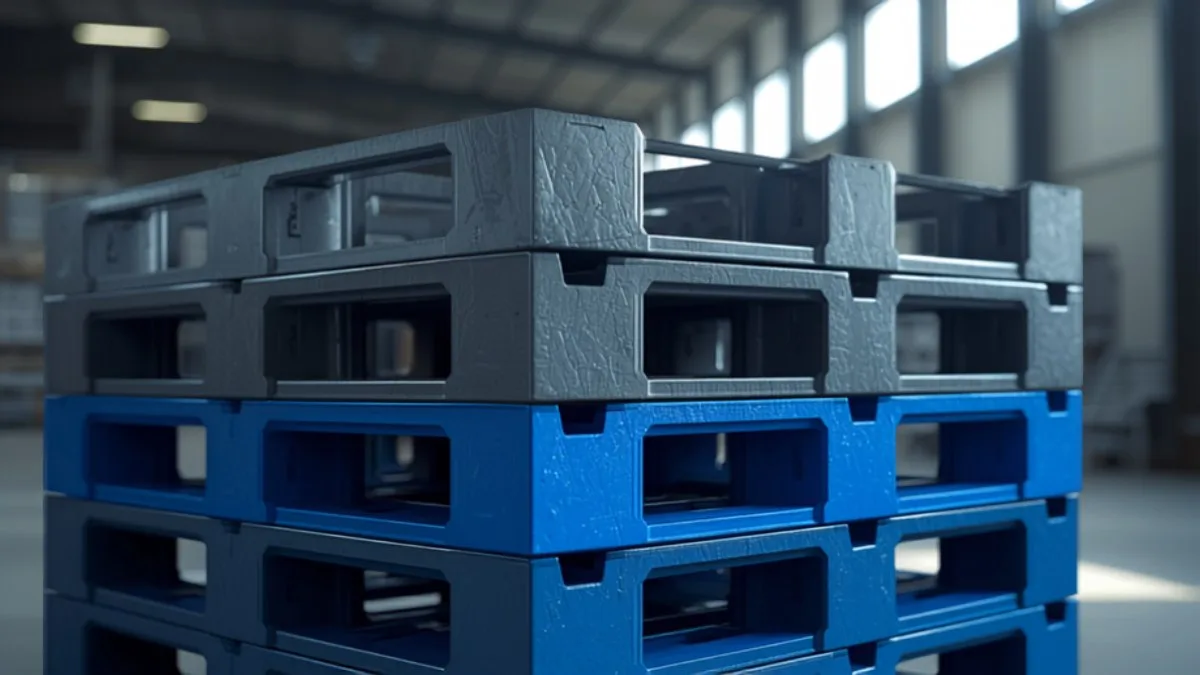
The word "plastic pallet" hides a decision that quietly shapes your storage cost, your racking safety, and how much freight you pay to ship empties back. A nestable pallet and a rackable pallet can both be molded from the same HDPE resin and still behave like completely different tools on the warehouse floor. Choosing the wrong one means either paying for strength you never use or trusting a deck that was never rated to sit loaded on a beam rack.
This article walks through the main families of plastic pallets you will actually be quoted on in Los Angeles, what each is built to do, and the honest trade-offs between them. If you are still weighing the material question itself, our breakdown of wood versus plastic pallets covers that first decision in depth; here we assume plastic is on the table and the question is which kind.
Why Plastic Pallet Type Matters More Than Color
Buyers often describe what they want by color — "the blue ones" — when the property that matters is the structure underneath. Plastic pallets are separated by how they stack when empty, whether they can be loaded into racking, and how the deck and feet are molded. Those three traits drive the price far more than the resin color does. A pallet that nests to save return-freight space is a different mold, and a different price, than one engineered to hold a full load suspended on rack beams.
Most plastic pallets in circulation are made from HDPE (high-density polyethylene) or PP (polypropylene). HDPE is the common workhorse because it stays tough in cold and handles repeated impact, which is why it shows up so often in cold storage and beverage operations. The type families below all exist in both resins, so think about the job first and the material second.
Nestable Plastic Pallets
Nestable pallets have open feet rather than a full bottom deck, so empty pallets sit down inside one another like stacking chairs. A column of twenty nested pallets takes up a fraction of the space and the trailer volume that twenty flat pallets would, which is the whole point of the design.
- Best for: shipping programs where pallets go out loaded and come back empty, display and retail distribution, and any operation paying to move empties across town or across the country.
- The trade-off: because the feet are open, most nestable pallets are not rated to sit loaded on rack beams. They are built to be stacked on the floor or block-stacked, not suspended.
- Watch for: weight rating. A light nestable display pallet and a heavier-duty nestable shipping pallet look similar but carry very different loads.
Stackable Plastic Pallets
Stackable pallets have a full or partial bottom deck, usually with three runners or a closed perimeter. They do not nest, but a loaded pallet can be set directly on top of another loaded pallet without crushing the goods below, because the bottom deck spreads the weight. This is the general-purpose plastic pallet most warehouses picture.
- Best for: block-stacking loaded goods in a warehouse, closed-loop systems where pallets cycle between two sites, and mixed handling where forklifts and pallet jacks both need clean entry.
- The trade-off: they take full floor and trailer space when empty, so return freight costs more than with a nestable pallet.
- Watch for: whether you need true four-way pallet-jack entry, which not every stackable model offers on all sides.
Rackable Plastic Pallets
Rackable pallets are the heavy end of the range. They are engineered with reinforced runners, and often steel or fiberglass rods molded into the frame, so the loaded pallet can sit supported only at its two ends on rack beams without sagging. This unsupported span is the test a rackable pallet is built to pass and a nestable one is not.
- Best for: selective pallet racking, automated storage systems that demand tight dimensional consistency, and heavy or dense loads that need a predictable, repeatable pallet every time.
- The trade-off: they are the most expensive plastic type and the heaviest, and they do not nest, so you carry that cost on every empty return too.
- Watch for: the dynamic versus static load ratings and, most importantly, the racking load rating. A pallet can be strong on the floor and still not be rated for a beam.
Open Deck Versus Solid Deck
Cutting across all three families is the deck style. An open-deck top has gaps between the molded ribs, which sheds water and dust and keeps the pallet lighter. A solid-deck top is a closed flat surface that supports small or unstable items and is easier to wash down. Many food and pharmaceutical buyers choose solid-deck HDPE for exactly that hygienic, easy-to-clean surface, which is one reason plastic dominates so many food, pharma and cold storage operations across Southern California.
Matching the Type to the Job
There is no single best plastic pallet, only the right one for how it will be handled. A few common scenarios make the choice clearer:
- You ship to retail and pay to bring empties back. A nestable pallet usually wins because the return-freight savings add up over thousands of cycles.
- You block-stack loaded product in a warehouse. A stackable pallet with a full bottom deck protects the goods underneath and gives stable columns.
- Your loads live in selective racking. A rackable pallet is the safe answer, and trying to save money with a non-rackable pallet on a beam is the kind of shortcut that ends in a dropped load.
- You run cold storage or food lines. HDPE in a solid-deck, washable form holds up to wet, cold, and frequent sanitation cycles, which is why it is the standard in those rooms across the San Fernando Valley and Buena Park cold-chain corridor.
Many operations end up running a hybrid fleet: nestable pallets for the outbound-and-return loop, stackable pallets for in-house storage, and a smaller pool of rackable pallets for the racked positions. There is nothing wrong with that. The mistake is buying one type for every job and discovering that the savings on paper turned into damaged goods or a return-freight bill that never stops growing.
How to Buy Plastic Pallets in Los Angeles
When you call for a quote, the details that let us price honestly are the same details that prevent a mismatch: the load weight per pallet, whether the pallets go into racking, how they are handled when empty, the pallet size you need, and whether the line is food grade or general industrial. With that, we can point you to the right type instead of selling you more pallet than the job needs. We supply HDPE plastic pallets in nestable, stackable and rackable configurations across Los Angeles and Southern California, and we are glad to talk through the trade-offs before you commit. You can see the full range on our plastic pallets page or compare it against our wider pallet product line.
Not Sure Which Plastic Pallet You Need?
Tell us your load weight, whether the pallets go into racking, and how you handle empties. We will recommend the right type and send a fast, no-obligation quote.
☎ (213) 703-5326 English
☎ (323) 674-6876 Español
REQUEST A FREE QUOTERelated Articles
Wood vs Plastic Pallets
The first decision: which material actually fits your operation and budget.
Plastic Pallets for Food & Pharma
HDPE specs and hygiene for food processing, pharma and cold storage.
Plastic Pallets in SFV & Buena Park
Local cold-chain supply for processors in Sun Valley, Pacoima and Buena Park.