Pallet Construction
Block vs Stringer Pallets: Which One Your Warehouse Actually Needs
By Maynor Martinez, Bro Pallets LLC | Published April 25, 2026
The forklift operator at a 3PL in Carson approached a pallet from the side, lowered the forks, and hit a solid stringer. The pallet did not budge. Twenty seconds later he came at it from the front, lifted clean, and moved on. The pallet itself was fine. The geometry was wrong for the way that warehouse worked.
That single difference — how the platform is built underneath — is the line between a block pallet and a stringer pallet. Both haul freight. Both meet the 48×40 GMA standard. But put them in the wrong operation and one of them slows down every move on the floor.
The choice is rarely about quality. It is about how your team handles material, what your racking expects, and where the load is going next. Below is the working comparison — what each construction does well, where each one fails, and how to pick correctly the first time.
What Actually Sits Underneath
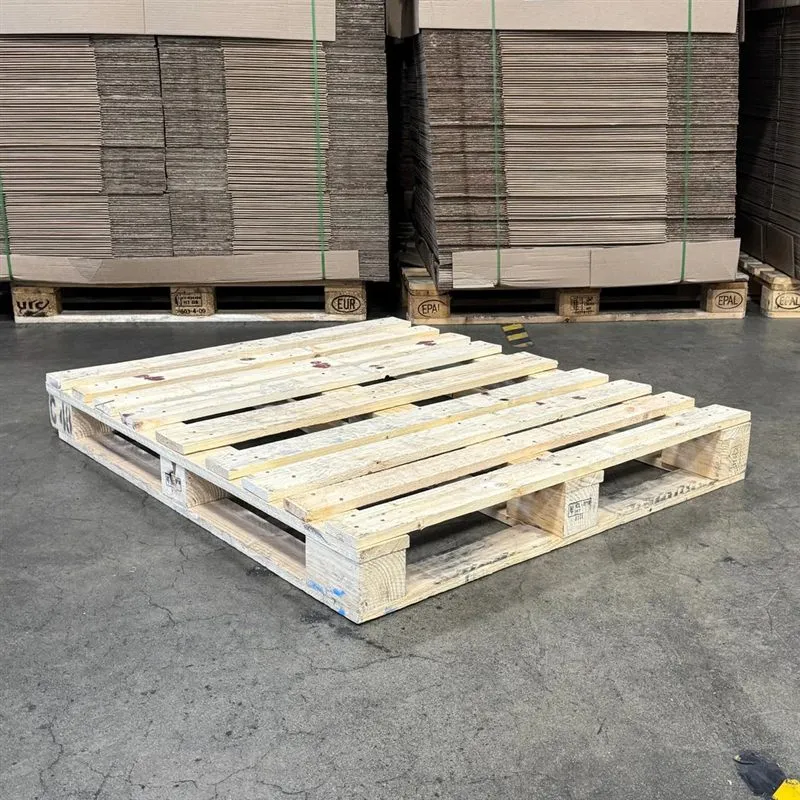
A stringer pallet uses three parallel boards running the long way of the pallet (called stringers) to support the deck. The deck boards sit on top of the stringers and the bottom boards underneath. Forklift forks slide between the stringers, which means access is limited to two sides — what the industry calls 2-way entry. Some stringer pallets are notched for partial 4-way access, but the front entry is still wider and stronger than the side entry.
A block pallet replaces the three stringers with nine solid blocks — one at each corner, one at each midpoint of the edges, and one in the center. The deck rests on those blocks instead of on continuous boards. Because the blocks leave clearance on all four sides, forks can enter from any direction. This is true 4-way entry, and it is the defining mechanical advantage of block construction.
The visual cue: look at the bottom. If you see three long boards, you have a stringer. If you see nine cubes with stringer-like rails connecting them, you have a block pallet. Most European EPAL pallets and the heavier ISO pallets are block-built. Most domestic 48×40 GMA pallets in U.S. circulation are stringer-built — though block pallets are gaining ground in retail and grocery distribution.
Where Block Pallets Earn Their Cost
Block pallets cost more upfront, sometimes 30 to 50 percent more than a comparable stringer. The premium pays back in a few specific scenarios.
Tight warehouses. When floor space is constrained, every move counts. A 4-way pallet lets a forklift come from any aisle without repositioning. Operations in Vernon and Commerce, where buildings were not designed for 53-foot trailers, often run faster on block pallets simply because the operator does not have to think about pallet orientation.
Heavier loads. Block construction distributes weight more evenly across the deck because there are nine support points instead of three continuous stringers. For static loads above 4,000 pounds, block pallets show less deck flex and a longer service life. This matters most for machinery, beverage product, and dense packaged goods.
Automated systems. Conveyor lines, pallet shuttles, and automatic guided vehicles depend on consistent pallet geometry. Block pallets present the same profile from any side, which removes a variable from the automation logic. Distribution centers transitioning to ASRS racking almost always specify block construction.
International shipping. Most countries that import on pallets standardize on block construction, especially if EPAL, ISO 6780, or Australian standard 1199 applies. If your export freight leaves through the Port of Los Angeles or Long Beach, ending up on a block platform reduces incompatibility at the destination.
Where Stringer Pallets Still Make More Sense
Stringer pallets dominate domestic LTL and FTL freight for a reason. They are cheaper, lighter by 5 to 8 pounds on a 48×40 footprint, and the supply chain knows them inside out. For most Los Angeles warehouses moving freight in and out of the same terminals, stringers are the right tool.
The cost advantage compounds at volume. A wholesaler turning over 2,000 pallets a month buys roughly 30 percent more units for the same budget on stringer construction. If the freight is moving over short domestic lanes and the load weight stays under 2,500 pounds — which covers the bulk of e-commerce, garment, and food product flows — the structural ceiling of a stringer pallet is rarely the bottleneck.
Stringers also recover and refurbish more easily. The flat continuous boards underneath are easier to inspect, easier to repair when a deck board cracks, and easier to disassemble for lumber recovery. The whole U.S. pallet recycling network — including the buyback flows we run through our own pallet pickup service in LA — is built around stringer geometry. Grade B and Grade C resale prices stay competitive because the supply pool is enormous.
How Forklift Choice Affects the Decision
One factor people overlook: the forklift, not the pallet, sets the access limit. A pallet jack only enters from the long side of a stringer. A counterbalanced forklift can take either side, but the operator must reposition before lifting from the short side of a notched stringer because the lift capacity drops. A reach truck inside narrow aisles needs the angle that block pallets allow.
Walk your operation before you order. If your team uses electric pallet jacks for most moves, stringers handle 90 percent of what you do. If your operation runs reach trucks, narrow-aisle forklifts, or any kind of robotic transfer, the time saved by 4-way entry usually justifies block construction.
Quick Reference: Construction Differences at a Glance
| Attribute | Stringer Pallet | Block Pallet |
|---|---|---|
| Forklift entry | 2-way (or partial 4-way if notched) | True 4-way |
| Typical static load | 2,500 to 3,000 lbs | 3,000 to 4,600 lbs |
| Weight (48×40) | 35 to 40 lbs | 40 to 50 lbs |
| Cost relative | Baseline | 30 to 50 percent higher |
| Common in | Domestic LTL, FTL, e-commerce, food | Retail DCs, automation, export, beverage |
| Repair friendliness | High — deep recycling pool | Moderate — block replacement is harder |
Choosing for Your Specific Operation
The decision usually breaks down to four questions. Walk through them in order before placing an order.
- Are forks coming in from all four sides? If yes, block. If no, stringers cover it.
- Does the load consistently exceed 3,000 pounds? If yes, block. If no, stringers handle it without flex.
- Is the freight going outside the U.S. or onto an automated system? If yes, block. If no, stringer is fine.
- What does your buyback or recycling supplier prefer? If your reverse logistics flow runs heavy on stringers, switching to block creates a sorting headache later.
For most distribution operations across Los Angeles, the answer is a mix — stringers for daily domestic outbound, block pallets reserved for export, automated systems, and heavy machinery. The cost difference is real, so saving block construction for the loads that actually need it controls spend without compromising operations. If your warehouse is in the Inland Empire running large-format DCs, the calculus often shifts toward block as automation takes more floor space.
For specifications and grade options, our overview of standard block pallets in stock covers what we keep on hand and what we build to order. If your operation needs both constructions on a recurring basis, splitting the order across our pallet product mix avoids the markup that comes with one-off purchases.
Frequently Asked Questions
Are block pallets always better than stringer pallets?
No. Block pallets are better when 4-way forklift entry, heavier static loads, automation compatibility, or international shipping is required. For the bulk of domestic LTL and FTL freight under 3,000 pounds, stringer pallets perform the same operationally at a lower price.
Can I mix block and stringer pallets in the same shipment?
Mixing is acceptable but creates handling friction. Carriers prefer consistent pallet geometry on a single trailer because it speeds loading and reduces miscalls during checkpoints. If you have to mix, group the same construction together at the pickup point.
Do GMA standards apply to both block and stringer pallets?
Yes. The 48×40 GMA dimensions and grading scale (A, B, C) apply regardless of whether the construction is block or stringer. The grade refers to the condition of deck boards, stringers or blocks, and overall structural integrity. Our breakdown of GMA grades A, B, and C applies equally to both styles.
Why does the block pallet weight more if it has fewer support pieces?
The blocks themselves are made of solid wood (or sometimes molded composite), which is denser than the dimensional lumber used for stringers. The deck boards on a block pallet are also typically thicker because the support points are spaced wider apart, so each board carries more bending load. The combined effect adds 5 to 10 pounds per pallet.
Need the Right Pallet Construction for Your Operation?
Tell us how your team handles freight and we will recommend block, stringer, or a mixed inventory that matches the way you actually move material.
☎ (213) 703-5326 English
☎ (323) 674-6876 Español
REQUEST A FREE QUOTE